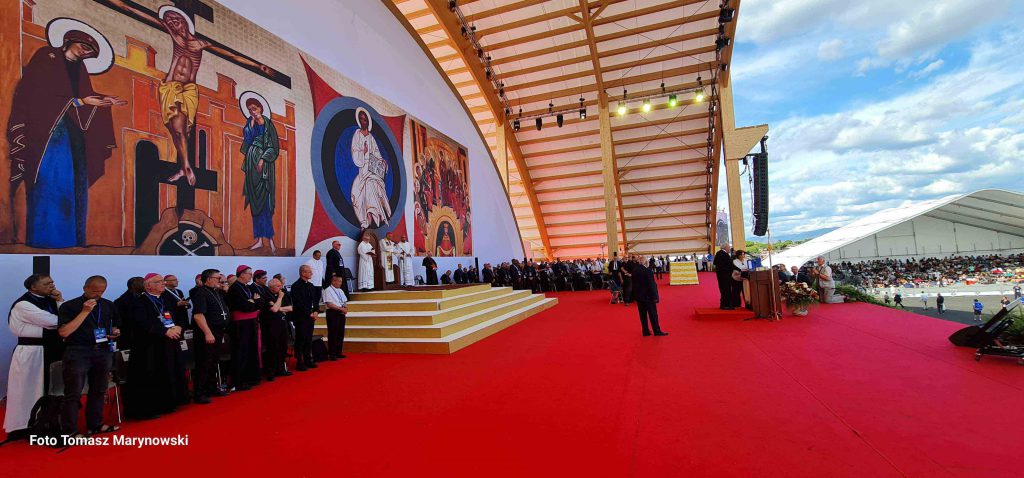
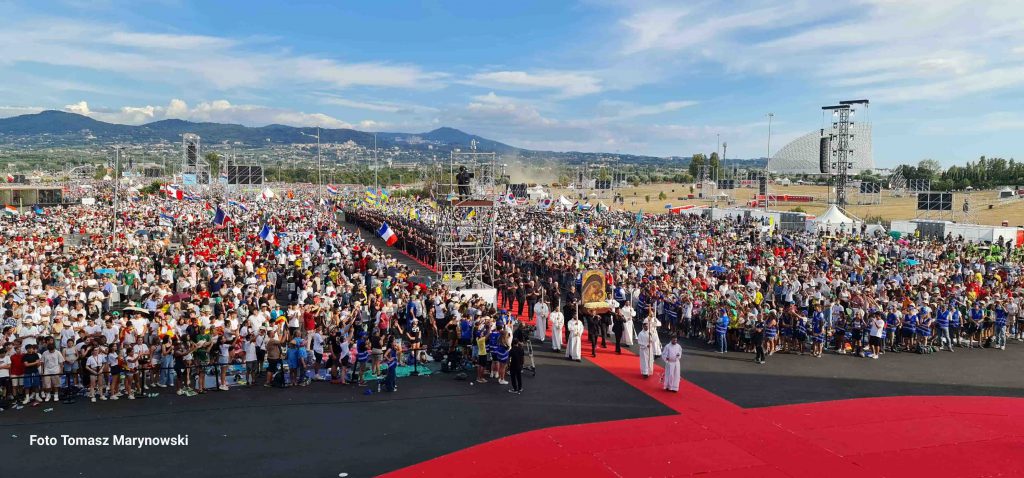
As a conclusion to the Jubilee of Young People, desired by Pope Francis and celebrated by Pope Leo XIV to restore hope to today’s world, 120,000 young people from the communities of the Neocatechumenal Way from 109 countries on five continents gathered this afternoon, August 4, at the same place where they met with the Pope, with the International Team, Kiko Argüello, María Ascensión, and Father Mario Pezzi.
On the large stage, where the Pope presided over the Vigil of Prayer, there were six cardinals, four archbishops, and 26 bishops, together with hundreds of itinerants and catechists who accompanied all these young people to Rome on a pilgrimage of prayer, but also of proclamation in various cities across Europe, where they spent the night during their long journey, involving local churches, communities, and civil authorities who welcomed them with signs of hospitality and acceptance.
The pilgrimage has thus become an opportunity to bear witness to the beauty of their faith, the joy of the days spent together, and the celebration of traveling to Rome to meet the Pope and to build their journey of faith on Peter.
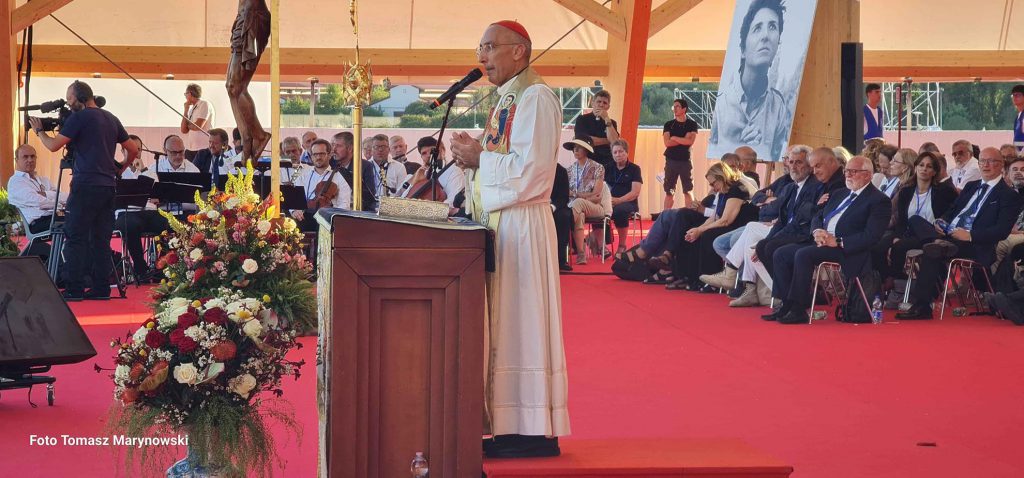
The meeting was presided over by Cardinal Baldassare Reina, Vicar of the Pope for the Diocese of Rome, who greeted the huge assembly.
In a spirit of celebration and true communion, amid the waving flags of some 50 countries from Europe, 30 countries from America, 11 countries from Africa (and others who were unable to attend because they could not obtain visas for the meeting), and 20 countries from the Middle East, Asia, and Oceania, it was possible to capture all the beauty of these days of this Jubilee of Hope. And these young people—together with the hundreds of thousands of other young people who have gathered in this eternal city of Rome, the place of martyrdom of the apostles Peter and Paul and thousands of other martyrs—can become true witnesses to the beauty of the Christian faith in an increasingly secularized and indifferent society.
The meeting was structured according to the model of the Vocational Encounters of other World Youth Days: Kiko, accompanied by Father Mario Pezzi and María Ascensión, briefly introduced the assembly before beginning the song, taken from the book of the prophet Isaiah, which opens and seals these encounters: “I am coming to gather all nations,” and the assembly is a living image of this.
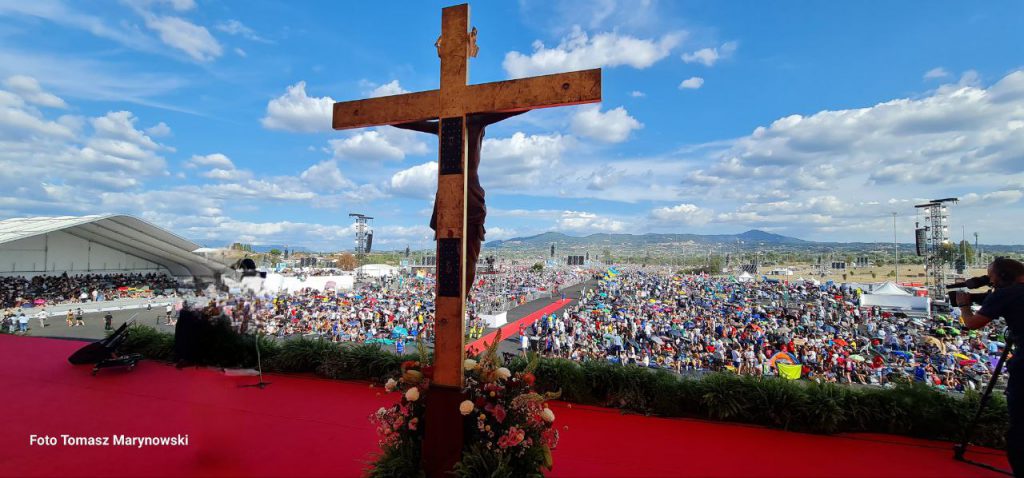
After the greeting by the Cardinal Vicar, accompanied by 100 priests from various Redemptoris Mater seminaries, the icon of the Virgin Mary made its solemn entrance onto the stage to preside over the meeting together with a large crucifix. A photo of Carmen Hernández, the servant of God who accompanied Kiko in opening the Neocatechumenal Way in the Church as a Christian initiation, currently present in 138 countries around the world, was also displayed.
After a few words from Ascensión, who introduced the young people to the figure of the Holy St. John Vianney (Cura de Ars), whom the Church commemorates today, the Word of God was proclaimed, taken from the Second Letter of Saint Paul to the Corinthians, a particularly powerful passage that invites us to “not receive God’s grace in vain.” This was followed by the singing of the Gospel of the day: Mt 9:35-10:1, a passage that was truly “ad hoc,” with the words of the Lord most appropriate for this vocational encounter: “The harvest is plentiful, but the laborers are few. Pray therefore to the Lord of the harvest to send out laborers into his harvest.”
And Kiko has resoundingly proclaimed the good news, which is always new, because it makes present God’s “HERE I AM,” his love, the death and resurrection of his Son Jesus Christ, who conquers human sin in order to launch us toward the fullness of life that is heaven: “What is God’s deepest desire?” Kiko asked. And he answered: “To give you the gift of the Holy Spirit, of his life, of his happiness.”
But to give you this gift, God needs your freedom, because, as St. Augustine reminds us: “God, who created you without you, will not save you without you.”
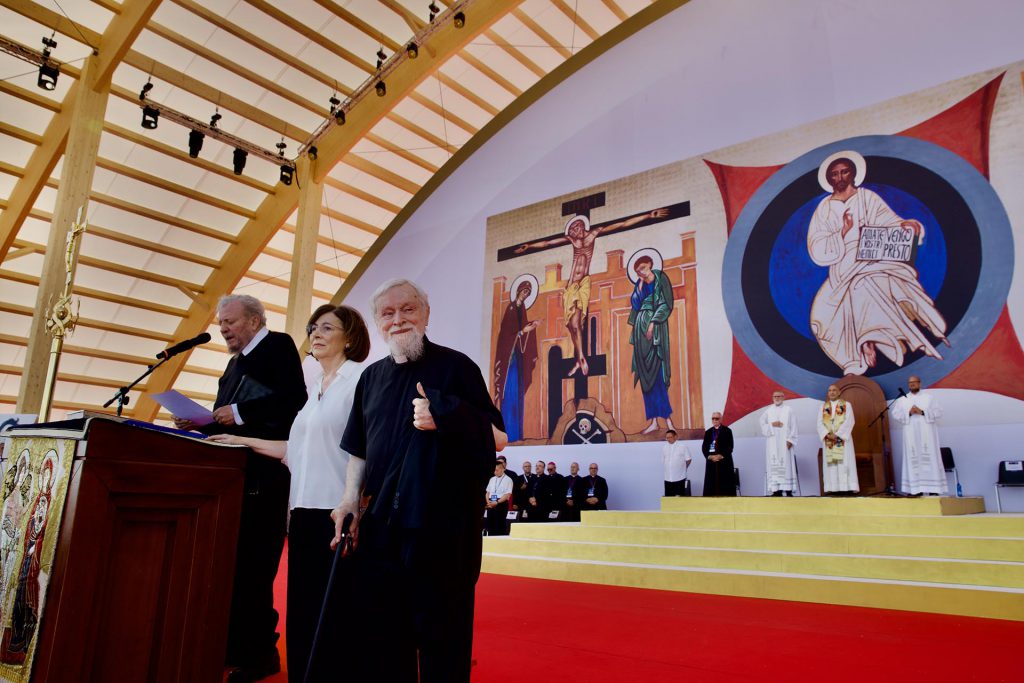
And Kiko, existentially rereading the Genesis account, has shown that after the serpent’s deception, the man who accepted the devil’s catechesis by disobeying God, by rejecting Him, finds himself lost, dead: it is not a moral problem, but an existential one: if God does not exist, if there is no Creator, who am I? What is the meaning of my life?
And finding himself without a true existential answer, man becomes perverted in the search for anything that can give him an answer: offering himself completely, but finding himself increasingly alone, incapable of love.
And man becomes a slave to loneliness, to the fear of death. Man now experiences the world from his own cosmogony, in a cosmos whose axis, whose center, is no longer God, but himself: his ego. This is sin. It is not something moral, but existential. This sin, which dwells in the depths of my being, compels me first to offer myself entirely to myself, because I am my own god and I want to be happy; I offer myself entirely to myself.
This is what prevents God from giving you his Holy Spirit, Kiko continued: the sin that dwells within you. And this is the meaning of our gathering this afternoon, of this Jubilee: Jesus Christ wants to give himself to you. St. Paul says: “The love of Christ impels us, because we are convinced that Christ died for everyone, and that he died for everyone. And he died for everyone so that those who live might no longer live for themselves, but for Christ.”
And Kiko, pointing to the cross of Christ, said: “I invite you to look at this cross: This is the image of freedom. The cross is the image of freedom. Here is a man who has given himself up for you, who will set you free so that you may give yourselves to others and stop offering yourselves only to yourselves. How can you receive the Holy Spirit today? If you accept that your self be crucified with Christ.”
He went on to recount the dialogue between Jesus and Peter after his resurrection. Peter had betrayed him, but Jesus did not abandon him; he sought him out and asked him, “Peter, do you love me?” And, turning to the young people, he said that the Lord asks each one of us this same question this afternoon: “Do you love me?” If we respond, He can give us the gift of the Holy Spirit: He can make us saints.
This is God’s passage among us, his call. The pilgrimage, the Jubilee, stands before this: GOD’S “HERE I AM.” This “Here I am” awaits your “Here I am” today, like the Virgin Mary.
And to seal the truth of this encounter, of what was being celebrated, after a few words from Father Mario, who recalled his call and invited the young people not to be afraid to respond to Jesus Christ, Kiko launched the vocational call to the assembly.
It was impressive to see how so many young people were waiting for this call, because as soon as Kiko finished speaking, many of them began moving toward the stage, forming a veritable river: from all the groups, from all the countries, speaking all the languages, dressed in all styles, on their way to respond to the Lord’s call.
First the boys, 5,000 of them stood up; and then the girls, 5,000 of them stood up, and they went to the stage to receive the blessing of the cardinals and bishops. This first call will then be verified and matured in the various vocational centers, but having responded today to the Lord’s call can initiate a change of life that, as Kiko said, corresponds to God’s plan: to make you holy!
The Cardinal Vicar concluded the meeting with words of hope. Here are some of them: “After accepting the Kerygma, aspire to greater things, to holiness”; “May this be the response to Pope Leo’s call”; “The Lord has addressed this invitation to us, the Lord calls us all to holiness”; “Always leave room for the Word of God, because God takes nothing away from our happiness”; “For some of you today, a path to happiness is opening up, to a life that is full, full of God, full of happiness.”