

November 24th, 1930, † Madrid, July 19th, 2016
Carmen Hernández Barrera was born in Ólvega (Soria, Spain) on November 24, 1930, the daughter of Antonio Hernández Villar and Clementa Barrera Isla. She was the fifth of 12 children (three of whom died in infancy) and was baptized on November 28 at the parish church of Santa María la Mayor in Ólvega. When she was three months old, she moved with her family to Tudela, returning to Ólvega for vacations.
Between 1935 and 1945, she attended the Colegio de la Compañía de María in Tudela. Her family, of humble origins, gradually saw their financial situation improve thanks to her father’s entrepreneurial spirit. In 1945, they moved to Madrid, and it was there, at the Jesús-María school, that she continued her studies until 1948.
The years Carmen spent in Tudela were particularly significant in her life. In fact, right next to the school where she studied stood the Jesuit school “San Francisco Javier,” which was regularly visited by missionaries from all over the world—India, Japan, the Americas—through whom the Lord awakened in her a calling to the mission. From a very young age, she felt this vocation, which she wanted to pursue with passion, despite conflicts with her family; she even tried several times to run away from home to go on the missions, but her father prevented her from doing so.
She studied and completed her degree in Chemistry at the Complutense University of Madrid with outstanding results. She then worked in several family businesses until, in 1954, she abandoned the promising career her father had envisioned for her to follow Christ, entering the Institute of the Missionaries of Jesus Christ, which had recently been founded in Navarre.
Between 1955 and 1956, she completed her novitiate year at the Javier Missionary Institute and took her temporary vows on October 3. In 1957, he entered the formation house of the Missionaries of Jesus Christ in Valencia and began his studies in Sacred Sciences (Theology), which she completed in 1960 with a thesis on “The Necessity of Prayer in the Thought of Pius XII,” earning a final grade of summa cum laude. In Valencia, she had the opportunity to meet Bishop Marcelino Olaechea y Loizaga; he, who as Archbishop of Pamplona had already supported the founding of this Missionary Institute, now assisted the Missionaries in Valencia and would be a precious guide for Carmen.
In 1960–1961, she lived in London to study and improve her English, thus preparing herself for the mission to India to which she felt called. However, in the winter of 1961, a telegram from her superior summoned her to return to Spain, to Barcelona, where she arrived in January 1962. Due to some internal disagreements, the superiors of the Institute decided that Carmen and some of her companions must leave the Institute before making their perpetual vows in October.
This setback in his missionary project, which caused her great suffering, coincided with her encounter with theologians who were preparing the liturgical renewal that was taking place during the Second Vatican Council; in this way, she was able to see her suffering illuminated by the Paschal Mystery of the death and resurrection of Jesus Christ.
In Barcelona, she has the opportunity to meet Father Pedro Farnés Scherer, a Spanish liturgist who teaches courses on liturgy and is closely involved in the liturgical renewal movement. Carmen attends his classes.
On August 28, 1962, Carmen had to leave the Institute of the Missionaries of Jesus Christ. In light of Father Farnés’ teachings on the Paschal Mystery, she would experience this time as a call from the Lord to offer up her “Isaac”: the vocation to mission she had felt since her youth. This event in her life made her very sensitive to what the Council was offering the Church through the Constitution *Sacrosanctum concilium*, a treasure that Carmen would bring to the Way through her catechesis on the Paschal Mystery and the Eucharist.
Carmen, along with the other sisters who have left the Institute of the Missionary Sisters, moves to Casas Antúnez, a working-class neighborhood in Barcelona, and works in a factory, hoping that one day she will be able to share the Gospel with the female workers… But that day never comes, so, together with her sisters, she considers going on a mission among the miners of Bolivia.
But before leaving for the mission, following the example of so many saints, she decided to make a pilgrimage to the Holy Land, following in the footsteps of the Word of God and proclaiming it in the very places where it was fulfilled. There, the Scriptures opened up to her in a surprising way, and she saw how, for the renewal of the Church, it was necessary to return to the origins of the Christian community and to the Jewish roots of Christianity. This existential experience would allow Carmen to embrace the conciliar constitution *Dei Verbum* with special attention and depth, so that she could later pass it on, together with Kiko, to the Way. On August 7 of that year, 1963, she set sail from Marseille bound for Israel.
On January 5, 1964, during Pope Paul VI’s visit to Palestine, Carmen was present as he passed through Nazareth. There she met Father Gauthier, founder of the religious community “The Companions of Jesus the Carpenter,” where men and women can live a religious life together. This opened her eyes to a new way of living the religious life.
On July 5, 1964, Carmen returned to Barcelona expecting to find her companions there, but they were in Madrid. On July 12, she traveled to Madrid to reunite with her family and companions and prepare for the mission in Bolivia. On July 15, her sister Pilar Hernández told her about Kiko Argüello and what he was doing with the poor. In September, she got in touch with Kiko Argüello, who in November decided to go live among the shantytown dwellers of Palomeras Altas; there, in 1965, a small community began to form among the poor. Carmen got to know this community and was surprised to see that these poor people were interested in getting to know Jesus Christ. Carmen began to spend time with the community and decided to move to live nearby.
On August 28, 1965, the Civil Guard began demolishing the shanties in Palomeras, starting with Carmen’s. Kiko managed to convince the Archbishop of Madrid, Monsignor Casimiro Morcillo, to come to their aid and stop the demolition. The archbishop, who had just served as secretary of the Second Vatican Council, met with the community that had formed there, blessed them, and invited them to bring this experience to the parishes of Madrid. This event helped Carmen decide not to leave for Bolivia, but to join Kiko in the work of evangelization. And here, among the poor of Palomeras, where Carmen saw a “Christian community” take shape, the other conciliar constitution, Lumen gentium, was revealed to her: the mystery of the Church made present in history through a community of brothers and sisters of different ages, cultures, and social backgrounds…
It is striking to see how Carmen’s life—the elements that make up its fabric—seem to be intrinsically linked to the post-conciliar Constitutions: God prepared her to embrace the content of these texts (the Paschal Mystery, the Word of God, the Church/community) through the events of her own life: leaving the Institute, the pilgrimage to Israel in the footsteps of the Word of God, the shantytown community), so that they might become the framework and content of the catechesis that, together with Kiko, shaped a form of Christian Initiation, recovering and adapting to the present day the practice of the ancient catechumenate, just as the Council itself requested: “The catechumenate for adults, divided into distinct stages…, established for proper instruction…” (SC 64). It is the “tripod”—Word, Liturgy, Community—that forms the foundation of the Neocatechumenal Way.
In 1966, Kiko and Carmen began giving catechesis at a parish in Madrid, and in 1967, at San Frontis (Zamora). On March 26, they celebrated their first Easter Vigil in Fuentes (Segovia). In November, they began giving catechesis in Ávila and met Don Dino Torreggiani, who invited them to Rome.
In June 1968, Kiko and Carmen traveled to Rome. Kiko went to live in the Borghetto Latino, and Carmen stayed with the Sisters of St. Bridget. Don Dino took them to visit the Shrine of Pompeii to place their work under the Virgin’s protection. They visited several parish priests in Rome, who showed no interest, but through some young people working among the shantytown dwellers of the Borghetto, they came into contact with their parish, that of the Holy Canadian Martyrs. Accompanied by Father Francesco Cuppini of Bologna, who served as the team’s priest, they gave catechesis between September and November 1968, and the first community of the Canadian Martyrs was born in Rome.
In late November, they were in Lisbon, at the parish of Penha de França, for their first catechesis in Portugal. This was followed by tireless evangelization work in Spain, Italy, and France.
In July 1971, Father Francesco Cuppini returned to his diocese in Bologna, and the young priest from Ávila, Jesús Blázquez, replaced him as the team’s priest in Spain. Father Mario Pezzi was invited to accompany Kiko and Carmen during their evangelization periods in Italy until 1982, when he was called to join the team responsible for the Neocatechumenal Way, a role he continues to fulfill to this day.
Many events in Carmen’s life are now intertwined with the development and history of the Way.
Carmen cared only about fulfilling God’s will, and this gave her the freedom of spirit and courage characteristic of the great figures of the Church. She was gifted with rare intelligence and a remarkable capacity for work, and she received a providential scientific and theological education for the mission to which the Lord was calling her, together with Kiko Argüello: the Neocatechumenal Way. A scholar of the Holy Scriptures, the early Church, the origins of Christianity, the Jewish roots of Christianity, and the traditions of the Jewish people, she masterfully united the Old and New Testaments in her catechesis; she was also deeply knowledgeable about Church history and the Magisterium. An enthusiast of the Second Vatican Council, especially of Lumen gentium, Dei Verbum, and Sacrosanctum concilium, with the rediscovery of the Paschal Mystery: the Council’s Constitutions that form the basis of the renewal that the Way, as a journey of Christian initiation, is bringing to the Church.
Carmen has truly traveled the world proclaiming the Gospel, working alongside Kiko Argüello to inspire hundreds of vocations to the priesthood, religious life, and missionary work, while also involving entire families. She preached the Gospel to thousands of young people who enthusiastically cheered her on, for she always had a truthful and radical message for them, never afraid to go against the grain. She spoke courageously about abortion, the value of motherhood, false forms of feminism, the destruction of the family… but, above all, about the love of God manifested in Jesus Christ, with whom she was always in love, as is evident in her preaching and her personal writings. She maintained a special bond of friendship with St. John Paul II. The great love she nurtured for the Popes and for the Church, and above all the depth and originality of her catechesis, make it possible to consider Carmen Hernández one of the most important women of the Catholic Church in the 20th century.
On May 16, 2015, she received, along with Kiko, an honoris causa doctorate in Theology from the Catholic University of America (CUA). The University wished to confer this doctorate in recognition of her dedication to the poor, which has led many of them to communion with Christ in the Catholic faith. Carmen deserves recognition for her invaluable contribution to the formation of the theological-catechetical synthesis of the Neocatechumenal Way: her profound knowledge of the Holy Scriptures and the Jewish world, her engagement with the entire post-Vatican II renewal, especially through Father Farnés, and her understanding of the ancient catechumenate and the history of the Church made possible, together with Kiko, the itinerary of Christian Initiation in the Church today.
The private writings published after her death, drawn from her diaries, have revealed to us a Carmen afflicted by great spiritual suffering, who often lived in a “dark night” amid countless journeys and ceaseless missionary activity. To these trials, beginning with her fall in Seoul Cathedral (2010), various other sufferings would be added until her death. Despite everything, she did not abandon evangelization, alongside Kiko and Father Mario, until the very end. Her last trip was to her beloved Holy Land, four months before her death, to accompany Kiko during the bishops’ meeting at the Domus Galilaeae (Israel) during Holy Week in 2016.
On July 19, 2016, at 4:45 p.m., Carmen Hernández was called to God’s presence at the age of 85, and on July 21, her solemn funeral was held at the Almudena Cathedral, presided over by the then Archbishop of Madrid, Cardinal Carlos Osoro, accompanied by Cardinals Stanisław Rylko, Antonio María Rouco, Ricardo Blázquez, Carlos Amigo, and the Apostolic Nuncio to Spain, Monsignor Renzo Fratini, who read a message from Pope Francis: “I was deeply moved to learn of the death of Mrs. Carmen Hernández, after a long life marked by her love for Jesus Christ and a great missionary zeal… I give thanks to God for the witness of this woman, inspired by a sincere love for the Church, who devoted her life to proclaiming the Good News…”. In his remarks, Father Mario commented: “I believe historians will delve into this fact: the founding of an ecclesial reality carried out by a man and a woman who have been constantly collaborating together,” and this for more than 50 years. Rabbi Rosenbaum, in his letter of condolence upon Carmen’s death, wrote: “Carmen was a tsaddiqah, a holy and righteous woman, a woman of prophetic vision and boundless love for the children of God. I had the privilege of knowing her and of being able to experience together the Ruah haqqodesh, the spirit of holiness that she possessed in a unique way.” These words come as no surprise, since Carmen, ever since she had the opportunity to visit Israel in 1963, professed a great love for the Holy Land and passionately conveyed it to the brothers of the Way. Carmen’s funeral was marked by celebrations held in numerous cathedrals and churches around the world.
His body rests in the garden of the Redemptoris Mater Seminary in Madrid and is visited by thousands of people from all over the world. Every year on July 19, in memory of his passing into Heaven, thousands of brothers gather in prayer in numerous parishes and dioceses around the world.
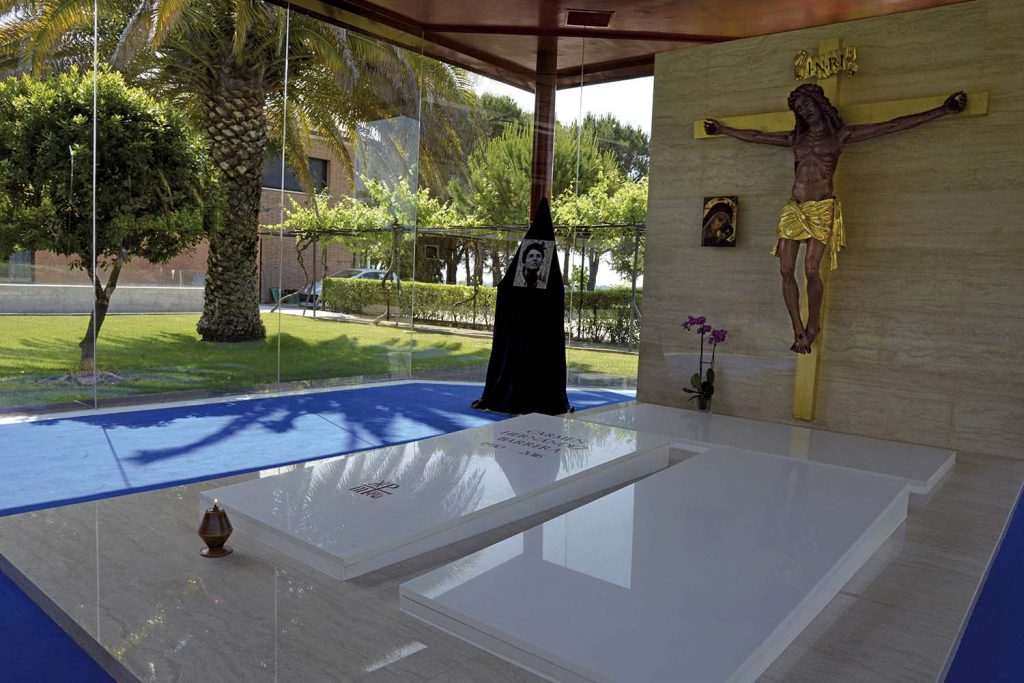
On December 4, 2022, the then-Archbishop of Madrid, Cardinal Carlos Osoro, in the presence of 50 bishops, opened the diocesan phase of the cause for the beatification and canonization of Carmen Hernández, who was declared a “Servant of God.” On June 2, 2026, Cardinal José Cobo Cano, the current Archbishop of Madrid, declared the diocesan phase concluded and forwarded all the documents to the Dicastery for the Causes of Saints in Rome.
Ten years after her death, her tomb has been visited by more than 120,000 brothers and sisters from over 100 countries. In the cause for her canonization, more than 15,000 favors and graces have already been recorded, along with 60,000 requests for intercession. People from all five continents seek her help on countless occasions.
Tributes in honor of Carmen Hernández
Award from the Israeli Ministry of Tourism as a token of gratitude and friendship (Jerusalem, 2004).
On May 27, 2018, Kiko Argüello presented the symphony “The Suffering of the Innocents,” a symphonic-catechetical celebration held at the Co-Cathedral of Soria in honor of Carmen Hernández. The event was presided over by the bishop and attended by civil authorities.
In some cities, squares and streets have been named in her memory: three in Italy, one in Albania, and another in Brazil. In Tudela (Navarra), a commemorative plaque was unveiled in 2023 in the city where Carmen spent most of her childhood, and another was unveiled in 2024 at the Colegio de la Compañía de María, where she spent her school years.
In 2024, the “Domus Bethaniae,” a center for the formation of priests, was inaugurated in Jerusalem: thanks to Carmen’s love for the Holy Land, the center was inaugurated at Easter and placed under the patronage of the Servant of God Carmen Hernández.
Published books
- Carmen Hernández Barrera, Diaries – 1979–1981, edited by J. Sotil and E. Pasotti, BAC, Madrid 2017 (in Spanish, Italian, French, English, Polish, Portuguese, Croatian, Korean, Hungarian, and Russian).
- Carmen Hernández Barrera, The Necessity of Prayer in the Thought of Pius XII, edited by R. Orozco and A. Carrascosa, De Brouwer, Bilbao 2024 (in Spanish, Italian, Portuguese, and Polish)
- Aquilino Cayuela, Carmen Hernández – Biographical Notes, BAC, Madrid 2021 (in Spanish, Italian, French, English, German, Dutch, Polish, Portuguese, Croatian, and Russian)
- Giorgio Ricci, Judeo-Christian Symbols Between Science and Faith: Reflections with Carmen Hernández, Chirico, Naples 2021 (in Italian, Spanish, and English).
- Francesco G. Voltaggio – Paolo Alfieri, Todas mis fuentes están en ti – The Servant of God Carmen Hernández in the Holy Land, BAC, Madrid 2023 (in Italian, Spanish, English, Portuguese, Polish, and Arabic).
- Carmen Hernández Saldaña, Women of Soria in History, Soria Edita 2023 (featuring a chapter dedicated to the Servant of God Carmen Hernández Barrera).
- Gianfranco Santini, A Saint for a Friend – Seven Stories, Tau Editrice, Todi (Perugia) 2024.
- Josefina Ramón Berná, Undivided Heart – Mission and Virginity in Carmen Hernández, BAC, Madrid 2025 (in Spanish, Italian, Portuguese, French, English, German, Dutch, Polish, Chinese, Czech, Romanian, and Swedish).
- Charlie Metola – Isabel Banderas, The Servant of God Carmen Hernández: Her Life and Mission in 50 Questions, BAC, Madrid 2025 (in Spanish, Italian, Portuguese, Polish, English, and German).
- José Casas – Jorge Borrell. Light and Darkness, Bless the Lord: The Servant of God Carmen Hernández Barrera in Barcelona (1962–1964). A Brief Historical Study. Desclée De Brouwer, Bilbao 2026.