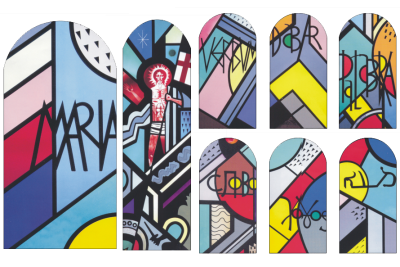
Iconography and stained glass
The paintings of the Neocatecumenal Way
Kiko Argüello studied Fine Arts at the Academy of S. Fernando de Madrid and in 1959 received the Premio Nacional Extraordinario de Pintura. In 1960, together with the sculptor Coomontes and the glassmaker Muñoz de Pablos, he founded the art research and development group called Arte Sacro “Gremio 62”. They held exhibitions in Madrid (Biblioteca Nacional), and represented Spain, appointed by the Ministry of Cultural Relations, at the Universal Exhibition of Sacred Art in Royan (France) in 1960. He exhibited some of his works in Holland (Gallery “Nouvelles images”).
Corona Mistérica
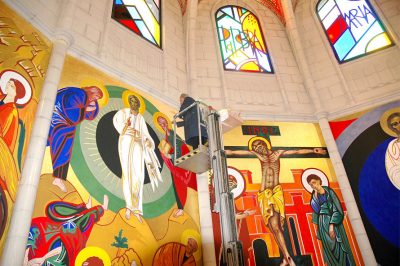
«Only a new aesthetic will save the Church». The images of this «mystic crown» want to influence the depths of the spirit of the faithful that contemplates it. They are intended to help man rise to God. These paintings act in the soul of the Christian as in the Transfiguration, where the apostles perceived the brightness of the divine light over Mount Tabor. Like him, they hear the Word of God and especially in the liturgy, these images, in a direct, immediate and more emotional way, want to help the spiritual transformation of the faithful. St. John Damasceno, who defended the icons against the iconoclastic force and was proclaimed as Doctor of the Church by Pope Leo XIII, said: «I have seen the human image of God and my soul has been saved».
May the Holy Face of Christ help you to witness his love.
Kiko Argüello.
Architecture
The architecture of the Neocatecumenal Way
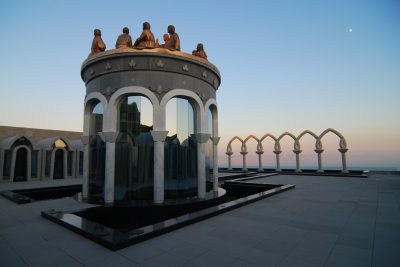
Throughout history, the Church has always perceived this connection between beauty and evangelization and the Church has been the largest patron of beauty. Everything reflects the beauty of Christ and the beauty of the community and of the fraternal communion. The evangelization of the Slavs took place in large part through the beauty of the liturgy, of the icons and the songs. Only in recent years, including within the Church, does a functional vision appear that reduces the places where the community lives and where they meet in simple meeting rooms.
However, today more than ever, is it necessary and urgent that the structures of the Church be renewed. The response to the global village, to the big city, to a monoculture, is a parish that becomes a “celestial village”, a more human social model, capable of opening spaces for the new civilization of love, a Eucharistic assembly that favors the active participation of the faithful, a reality of community of communities with a catechumenium composed of beautiful liturgical rooms for celebrations in small communities.
In the five continents you can find works designed by Kiko within the new aesthetic: the Redemptoris Mater Seminaries, new parishes, catechumeniums, rooms for community celebrations, etc.
Sculpture
The sculpture of the Neocatecumenal Way
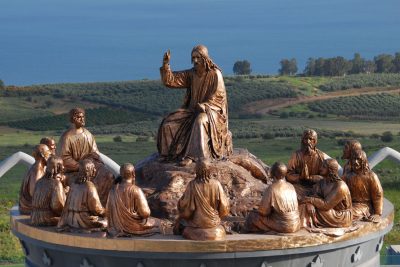
Dostoyevsky wrote “Beauty will save the world”. Beauty, as you know, is a transcendental of the being, along with goodness and truth. Because, as St. Thomas says, all reality is one, is true, is authentic. But for me, I like to relate beauty to pleasure. The aesthetic emotion, beauty, gives us pleasure, it gives us an emotion. Therefore God, in some way, has created nature. He who created nature, He has made it beautiful to give us pleasure.
Pleasure is in relation to love. And it is interesting, for me as a painter, as I have studied the laws of harmony, that everything in nature is related and is in function of beauty. Not everything is beauty, in a certain sense, but the laws of harmony are in a relationship of matter, form … It’s curious, the science that studies relationships is mathematics, so in harmony there are a whole series of equations that are mathematical. Already in art, Plato talked about the geometry and the mathematics of creation. In art, be it in painting, be it in sculpture, be it in music, whether in poetry, everything is in a relationship, relationships that are harmonious.
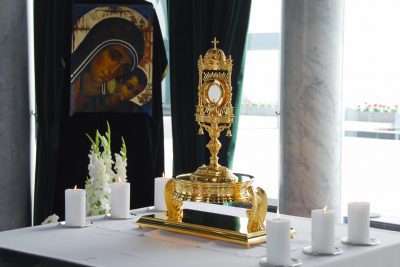
This mathematical relationship that exists within harmony also exists in time, exists in music. Music is very important because it teaches us beauty in time. Each note values the following in time, in painting every element matters, every smoothness, every material, each design, values the other. For example, Beethooven’s fourth symphony, begins with a dissonance. This is wonderful. Regarding time, valuing time, let us say that there is … Let’s not talk about poetry, the word, the sculpture. For example, Henry Moore, an English sculptor, has studied human bones, has seen that the bones of man … the cavity of the femur is perfect. That cavity is perfect for a joint function and at the same time it is aesthetic, totally It has an aesthetic curve, beautiful, it’s very difficult. The curve of a seal’s neck is wonderful. Regarding animals, not just any curve is aesthetic. Moore takes those cavities, studies them and makes a sculpture of curves, because a curve of a certain type corresponds to another protuberance of another type to be aesthetically pleasing, because everything is in relation.
Let’s say that in aesthetics there is a deep secret, which is love.
Kiko has designed many objects for the liturgy: chalices, patenas, censers, covers for the Bible, ornaments … he has also made many sculptures: Sermon on the Mount, St. John Paul II, Jesus Christ crucified, fawns, etc.
Books
Biographical notes – Carmen Hernández
Comprar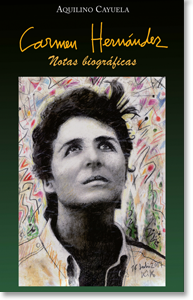
In these biographical notes you are going to see an exceptional woman, very important for the Church, in love with Christ, with Scripture and with the Eucharist. She was clearly aware that God had given her the mission to support, defend and correct me, for the good of the Neocatechumenal Way.
I thank God for Carmen who has always told me the truth, constantly. She was very smart, a profound, authentic and free woman in her relationships with everyone. She loved Christ and the Church and the Pope, above all else.
We believe that Carmen is with the Lord, she is already in heaven. These biographical notes are not only for the brothers of the Way, but for the whole Church, to make known an extraordinary woman, who has lived the faith to a heroic degree. Carmen Hernández! (Kiko Argüello).
Se publica la primera biografía oficial de Carmen Hernández. El quinto aniversario del fallecimiento de Carmen Hernández, 19 de julio de 2021, coincide con la publicación de su primera biografía oficial, cuyo autor es el profesor y doctor en Filosofía Aquilino Cayuela y edita la Biblioteca de Autores Cristianos (BAC).
The Kerygma. In the shacks with the poor
Buy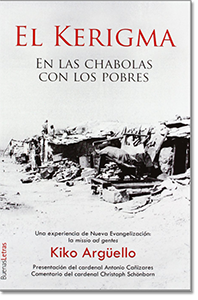
“I have wanted to write this little book per a request of Cardinal Cañizares, who thought it was important to say something about what the Lord has done with us in the shantytowns, with the poor, and also to publish a kerygma that could be a help, especially with the contents and the anthropology, to the Synod on the New Evangelization.” Kiko Argüello.
Cardinal Cañizares: “This book is a true gift from God, which encourages and supports us in faith, dispels fears and fills us with courage.”
Cardinal Schönborn: “In this catechesis, the entire proclamation of the Gospel is condensed in an impressive way.”
Annotations 1988-2014
Buy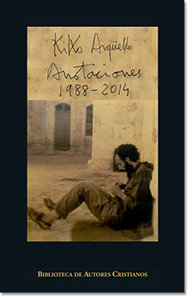
“Since almost thirty years ago, I have been writing in notebooks, in a sporadic and irregular way, and without any specific intention, some thoughts, reflections, maxims, memories, considerations, notes, prayers, soliloquies, etc., raised in me during the mission of evangelization and catechesis to which the Lord has called me in the Church, along with Carmen Hernández and Father Mario Pezzi. If these annotations can help someone, blessed be God.”
“The book is formed by small literary pieces which can be read without connection to the previous or the next. They are reflections from an event, a convivence or a gathering; spiritual jolts of announcement or denunciation; interpellations or calls to hope to which the reader feels connected; sometimes they are bold secrets that sprout from the soul of the author; sometimes they are a kind of hymn or psalm, of ardent supplications and of vibrant thanksgiving to God. From the data the small writings contain, you can somehow follow the historic thread from 1988 all the way to 2014. It is united more by the history of faith of its author and of the Neocatechumenal Way than by a thematic development, although many contents of the specific charism appear dispersed. It is a story full of joys and sufferings; it is evident the fight of the author to faithfully carry out the assignment received from God” († Mons. Ricardo Blázquez Pérez, Cardinal Archbishop of Valladolid).
Diaries 1979-1981
Buy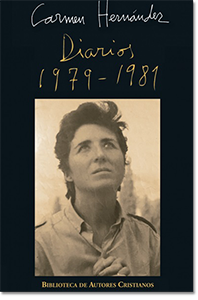
“It rains, but the day dawns serenely. Jesus, I am surprised. Thank you. The suffering has put mercy in my heart. Thank you, Jesus. Peace, joy….” Carmen Hernández, Valle de los Caídos – Madrid, January 27, 1979.
“Fifty years without stopping for a moment, of travel, of scrutinies, of visits to so many communities in Madrid, Zamora, Barcelona, Paris, Rome, Florence, Ivrea… Listening and listening to each brother about his life, his sufferings and his history, enlightening it through the light of faith, of the glorious cross of Our Lord Jesus. I think that you have the right to know Carmen’s heart, her immense love for Jesus Christ. She would say constantly: «My Jesus, I love you, I love you. Come, come, help me.” (Kiko Argüello).
The Neocatecumenal Way
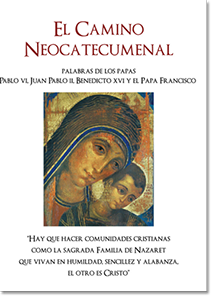
Words from the Popes : Paul VI, St. John Paul II, Benedict XVI and Francis.
The first apostles, in small teams of evangelization, traveled the synagogues announcing the Good News: God has raised his servant Jesus, the one of whom we have rejected, asking pardon for a murderer; he who died without opposing resistance, without resisting evil, loving his enemies, excusing them (“Forgive them because they don’t know what they are doing”); he who offered the evil that they inflicted on him – torture and the cross – as proof that his love was greater than death and never ceasing to love them, even if they took away his life: God has raised him from the dead and today He is alive, to forgive this and any other crime.
“Our time needs to resume the building of the Church, almost psychologically and pastorally, as if beginning again from scratch; so to speak, to regenerate.” Pope Paul VI, August 4, 1976.
Songs of the Neocatecumenal Way

Revised by the Neocatecumenal Diocesan Center of Madrid. The book of songs is edited in different colors to differentiate the gradual stages of the Way. The psalmists must choose the songs, according to the stage of the Way in which the Community is and wait for the Catechists to transmit the songs of the different convivences and Steps of the Way, in this way the brothers can understand the meaning of each song.
Orchestra
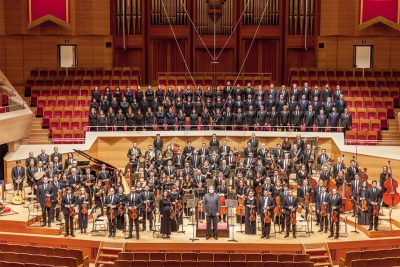
The Symphony Orchestra of the Neocatechumenal Way has been founded as a service of the Neocatechumenal Way to the evangelization through music.